Frequencies of the Future: The Impact of 432Hz and 528Hz
Myth or science? Can sound heal?
Have you ever heard that certain sound frequencies can calm, heal, increase focus, or even transform consciousness? Among the most popular are 432 Hz and 528 Hz, often associated with well-being, emotional balance, and therapeutic properties.
But what actually lies behind these claims? Where does science end and popular belief about sound frequencies begin?
The relationship between sound, the body, and behavior is real and has been studied for decades. What needs careful analysis is the idea that an isolated frequency could, on its own, have universal healing or transformative properties.

So, what is a sound frequency?
Frequency is the number of cycles of a sound wave per second, measured in hertz (Hz). In music, it is directly related to pitch: the higher the frequency, the higher the perceived sound.
When we talk about 432 Hz or 440 Hz in a musical context, we are usually referring to the frequency used as a reference to tune the A note above middle C. The international standard sets this A at 440 Hz, according to the ISO 16 norm.
This does not mean that 440 Hz is a “natural” frequency and all others are artificial. Different tuning systems and musical references have existed throughout history. The choice of a tuning standard is, above all, a musical convention.
It is in this context that the discussion about the famous 432 Hz arises.
432 Hz: science, experience, and myth
The 432 Hz tuning gained enormous popularity in content related to meditation, spirituality, and relaxation. Many interpretations present it as a “natural frequency,” supposedly aligned with the human body, nature, or the universe.
The problem is that these claims are far broader than the available scientific evidence can support.
This does not mean, however, that the comparison between 432 Hz and 440 Hz is irrelevant. Experimental research has attempted to investigate whether different tunings can produce distinct physiological responses.
A pilot study by Calamassi and Pomponi, published in 2019 in Explore, followed 33 volunteers who listened to the same music, composed of film scores, tuned to 432 Hz and 440 Hz. The researchers observed, in the 432 Hz condition, an average reduction of 4.79 beats per minute in heart rate, along with a slight reduction in blood pressure and higher satisfaction reported by participants.
The result is interesting but needs to be interpreted with caution. It was a pilot study with a small sample. The authors themselves recommended larger studies and randomized clinical trials before drawing definitive conclusions.
In other words: there are signals that justify further investigation, but this is very far from proving that 432 Hz “heals,” “reprograms DNA,” or possesses a universal therapeutic property.

And what about the famous 528 Hz?
Another frequency that has gained traction in digital culture is 528 Hz, often called the “love frequency” or “miracle frequency.”
It appears associated, especially in wellness videos and playlists, with promises of regeneration, cellular transformation, and even DNA repair. Here, the distinction between experience and scientific evidence is essential.
To date, there is no robust scientific evidence that listening to 528 Hz in isolation has specific healing properties, much less that it is capable of repairing human DNA.
This also does not mean that sounds in this range are incapable of provoking sensations or physiological responses. It simply means we cannot attribute therapeutic powers to an isolated frequency that have not yet been consistently demonstrated.
And this difference matters: a person may indeed feel relaxation, pleasure, or well-being when listening to certain music. The experience is real. What we cannot do is turn that experience into a universal scientific claim without sufficient evidence.

So does sound really affect the body?
Yes. And this is precisely where the conversation gets more interesting. Listening to or producing music involves multiple areas of the brain related to emotion, memory, movement, and cognition. Sound can also influence measurable physiological and psychological responses.
A review published in 2020 by de Witte and colleagues in the Health Psychology Review gathered 104 randomized controlled studies involving 9,617 participants. The researchers found beneficial effects of music interventions on physiological indicators such as heart rate, blood pressure, and hormones, as well as psychological effects related to stress, such as anxiety and restlessness.
The National Center for Complementary and Integrative Health (NCCIH), part of the National Institutes of Health, also recognizes evidence that music-based interventions can contribute to aspects related to stress, pain, anxiety, and well-being, although results vary depending on the intervention and the population studied.
The impact of sound, therefore, is real. It simply does not depend on a “magic frequency” to exist.
What matters more: the frequency or the sound experience?
This may be the most important question of all. A piece of music is not just a frequency. It is rhythm, melody, harmony, timbre, intensity, tempo, repetition, silence, narrative, expectation, and memory, all happening simultaneously.
Beyond that, there is each person’s individual relationship with that sound. The same music can relax one person and bother another. A specific frequency may be part of a positive experience simply because it is embedded in a composition, an environment, and a context that make sense to the listener.
It is this complexity that makes the study of the relationship between sound and behavior so fascinating, and also so resistant to simple answers. Instead of asking “which frequency heals?”, it may be more interesting to ask: how do different characteristics of sound influence our perception, emotion, behavior, and experience? This is a broader question and, scientifically, a far more promising one.
What does this have to do with Sound Branding or Sound Marketing?
Everything. In Sound Branding, the goal is not to find a universal frequency capable of making everyone feel the same emotion. The work is to understand a brand’s personality, its audiences, its contexts, and its touchpoints in order to transform strategic attributes into a coherent sonic language.
This language can involve a musical theme, a sound logo, brand voice, verbal tone, sound design, soundtracks, and other elements of the sonic ecosystem. The same principle applies to Sound UX.
In an app, a store, a circulation space, a customer service system, a digital environment, or a mode of transportation, sound actively participates in the experience. An alert needs to grab attention. A voice needs to convey confidence. Ambient music can create a certain atmosphere. And even silence communicates.
That is why thinking strategically about sound involves understanding frequency, volume, rhythm, timbre, context, and behavior, not in isolation, but together. Sound stops being a decorative element and becomes part of the experience a brand builds.
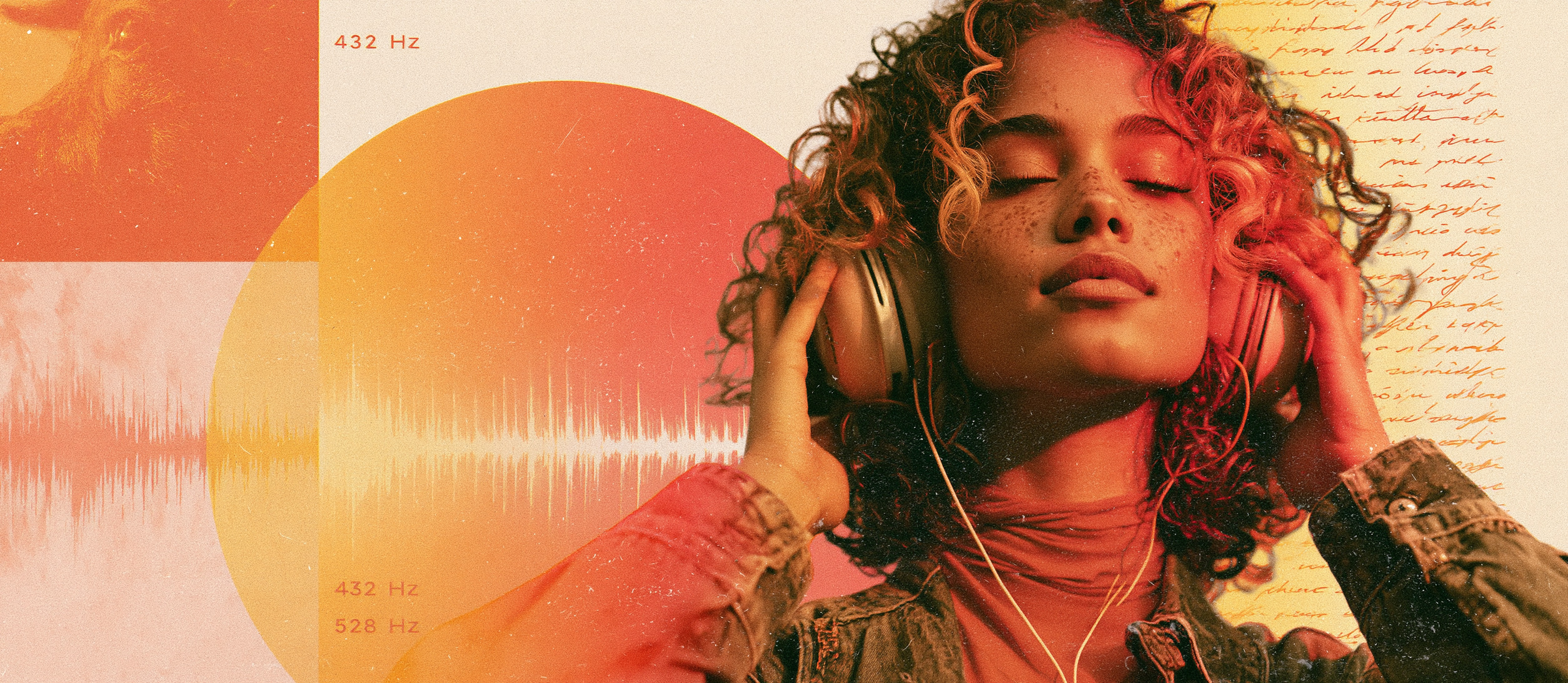
Will the frequency of the future be a specific frequency?
Perhaps not. The great discovery of the future may not be a single frequency capable of producing a specific effect, but an increasingly sophisticated understanding of how sound interacts with people and environments.
Neuroscience, music, technology, acoustics, behavior, and artificial intelligence can combine to create sound experiences that are increasingly personalized, intelligent, and intentional. That is why, instead of searching for a miracle frequency, the most promising path seems to be learning to design more human and strategic sound experiences.
We can affirm that sound has power: it awakens memories, provokes emotions, guides behaviors, creates recognition, and changes the way we perceive an environment. Science already offers important evidence about these relationships. What we still cannot affirm is that an isolated frequency is capable of producing universal effects or curing diseases.
And perhaps that is precisely the most fascinating part: we are still discovering what sound is capable of doing. For brands, this discovery opens an enormous territory. If sound participates in the way we feel the world, it also participates in the way we feel a brand.
Want to discover what your brand's frequency is?
Creating a sonic identity goes far beyond choosing a song or a frequency. It means transforming strategy, personality, and positioning into an experience that can be recognized, remembered, and felt.
At Zanna Sound, we develop Sound Branding, Music Branding, and Sound UX projects, creating sonic universes for brands and experiences.

Contact Zanna Sound and discover how to turn your brand’s sound into a strategic asset.

Next article
Sound Marketing: The Evolution of Sound Branding
The future of Sound Branding is Sound Marketing. How to create, apply, maintain, and monitor sonic brand consistency over time.
Read more